
PU and PVC wheels can look surprisingly similar when a sample sits on your desk. That creates a problem: a small material misunderstanding can become a large procurement issue after bulk ordering. I have seen this confusion in sample discussions many times, so I use three practical checks before I trust a material claim.
To tell PU and PVC wheels apart, start with appearance as a first filter, then compare touch, hardness, rebound, surface grip, and recovery feel. For controlled samples, smell or heat reaction may offer extra clues, but these checks are not 100% proof. For bulk orders, always confirm material specifications with the supplier.
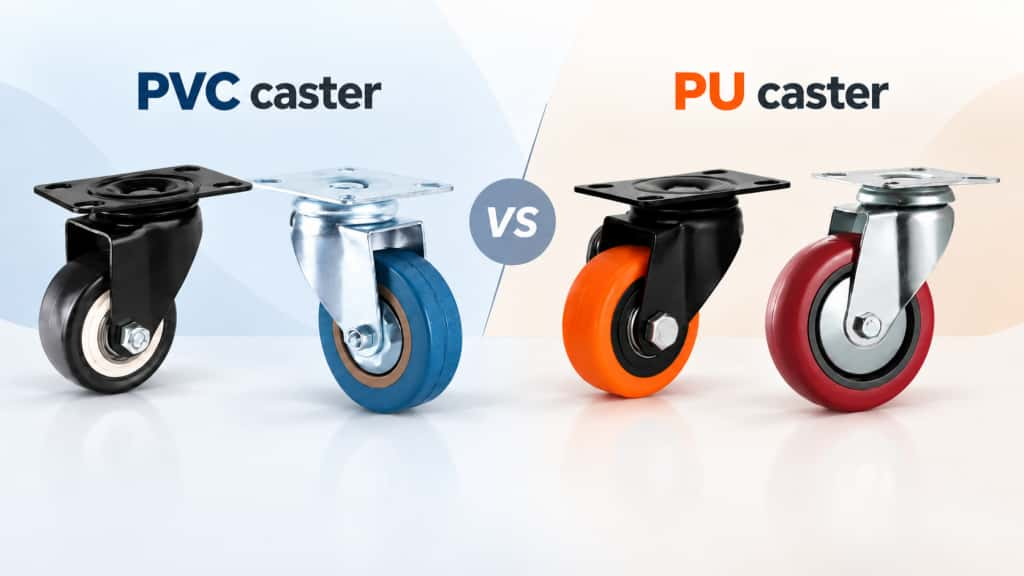
The goal is not to become a laboratory technician. The goal is to reduce purchasing risk. When I help distributors, hardware channel teams, or equipment manufacturers review caster samples, I treat material identification as part of supplier evaluation, not just a visual guessing game.
Can appearance help identify PU and PVC wheels?
Appearance can help you start the judgment process, but it can also mislead you. Many people expect PU to have a certain color, gloss, or transparent look. The problem is that PVC wheels can also be made with similar visual effects, especially in a competitive market.
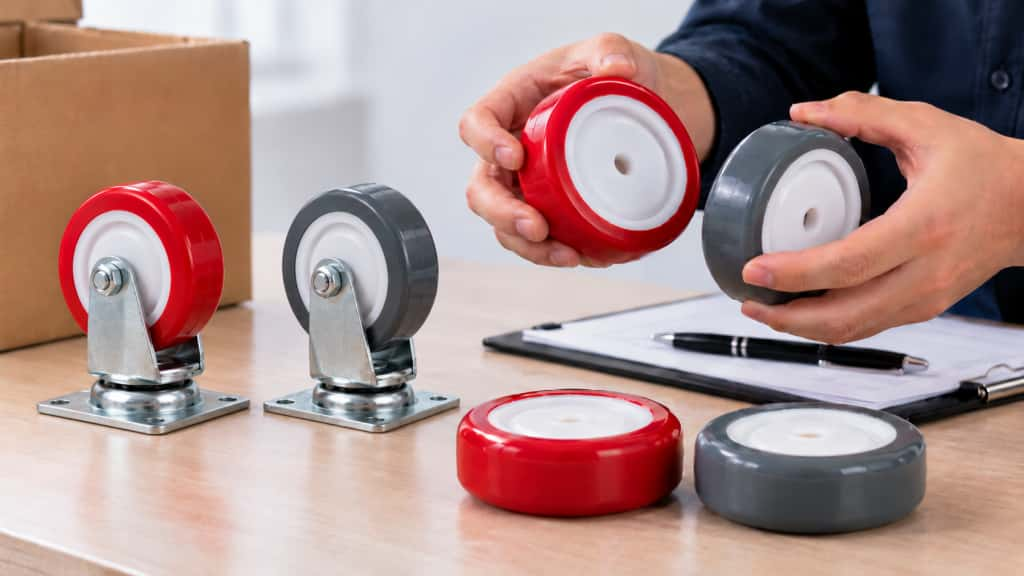
Appearance is useful as a first filter, not a final answer. You can compare color consistency, surface gloss, transparency, molding quality, and tread finish, but you should not decide that a wheel is PU or PVC based on appearance alone.
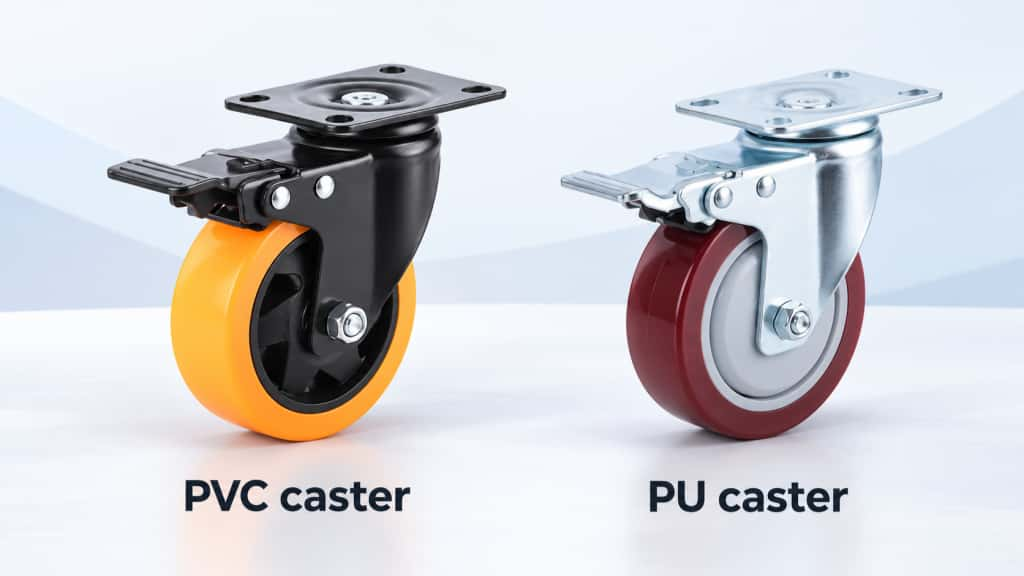
Why appearance is only the beginning
When I receive sample photos from customers, one common question is, “This looks like PU, right?” My answer is usually careful: “It may be, but we need more information.” The reason is simple. Appearance is easy to adjust during production1, while performance depends on the actual material formulation and manufacturing control.
In the caster market, PU and PVC wheels may appear in many forms:
- Red, gray, blue, black, orange, or translucent treads
- Glossy or matte surfaces
- Transparent or semi-transparent tire layers
- Smooth or slightly textured finishes
- Similar-looking molded edges
A junior purchasing employee may see a transparent wheel and assume it is PU. That is risky. Some PVC wheels can be made translucent. Some PU wheels may also be opaque.2 Color is even less reliable because pigments can be adjusted.
I treat appearance like a “warning light,” not a “test result.”
Visual details that deserve attention
Although appearance cannot prove the material, it can still reveal useful clues about manufacturing quality. During sample review, I usually check:
-
Surface uniformity
A stable tread surface usually suggests better process control. Uneven color or cloudy areas may require more questions. -
Molding edge quality
Rough flash, poor trimming, or visible defects can indicate weak production control, regardless of whether the material is PU or PVC. -
Bonding condition
For wheels with a tread bonded to a core, I check whether the tread looks firmly attached and whether there are gaps or bubbles. -
Batch consistency
One good sample does not guarantee stable bulk quality. I prefer to compare multiple samples from the same proposed production batch.
Quick appearance comparison
| Visual point | What people often assume | Practical procurement view |
|---|---|---|
| Transparent tread | Often assumed to be PU | Not definitive; PVC can also be made translucent |
| Glossy surface | Often linked with PU | Not reliable; surface finish can be adjusted |
| Bright color | Often seen as higher quality | Color does not prove material or performance |
| Smooth tread | Looks professional | Useful for quality review, not material proof |
| Good sample photo | Builds confidence | Still needs physical sample and confirmation |
If you want a broader comparison of material performance, I also recommend reading my related guide: PU vs PVC caster wheels. It explains how material choice affects use cases, cost, and expectations.
For procurement, the key lesson is clear. Do not reject appearance checks, but do not overtrust them. Appearance can help you decide whether to ask more questions. It should not be the only reason you approve a quote or place a container order.
How do touch and rebound help tell PU and PVC wheels apart?
Touch and rebound checks are useful because PU and PVC wheels often feel different under pressure, rolling, and recovery. The challenge is that hardness ranges overlap, and some high-hardness PU treads may not show obvious fingernail marks. So these checks help with initial judgment, not final verification.
You can press, bend, roll, and compare the tread feel of PU and PVC wheels. PU often shows better elasticity and recovery, while PVC may feel more plastic-like or less responsive.3 However, hardness, formulation, and temperature can change the result.
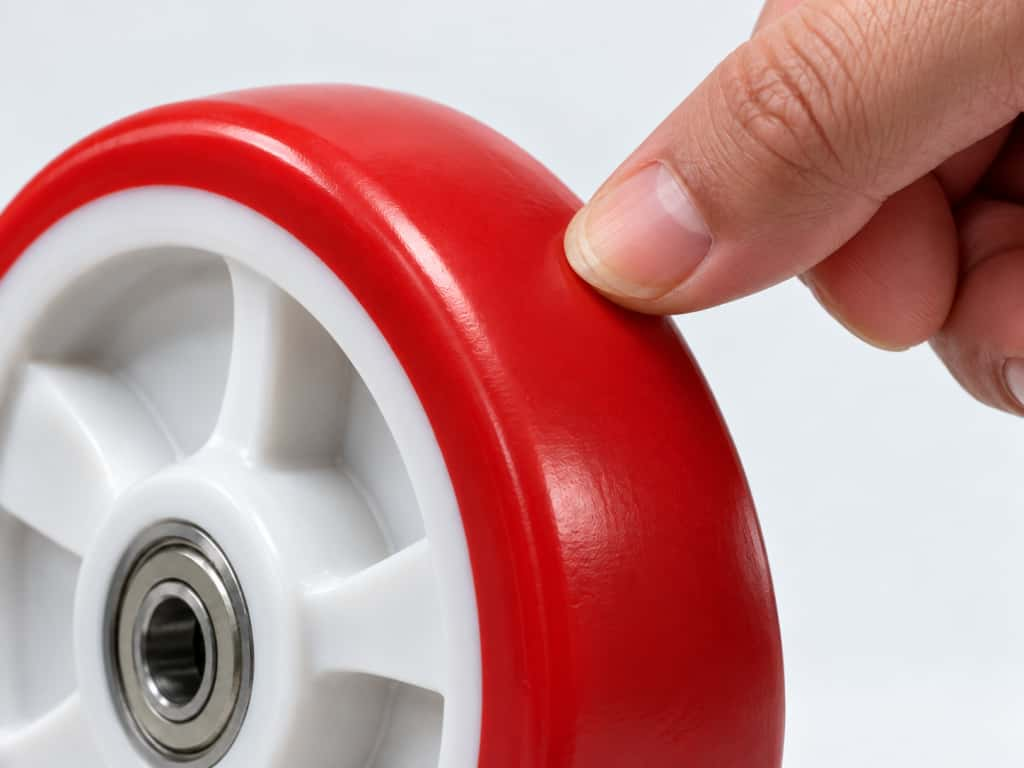
What I check by hand
When a sourcing team sends me a wheel sample, I like to compare it with a known reference wheel if possible. A side-by-side check is more useful than testing one unknown sample alone. I usually look at five points:
- Hardness feel
- Fingernail pressure response
- Elastic recovery
- Surface grip
- Rolling noise and vibration feel
These checks are practical because they do not require special equipment. They are also useful during early sample discussion, trade show evaluation, or incoming sample review.
The important limit: PU hardness can be high
This point matters a lot. PU wheel tread hardness can be 75°, 85°, 92°, 95° Shore A4, and sometimes other ranges depending on the application. When the hardness reaches a certain level, pressing with a fingernail may not leave any obvious mark.
That means a simple “nail press test” has limitations. If the wheel does not dent, it does not automatically mean it is PVC. It may be a high-hardness PU wheel designed for heavier loads, lower rolling resistance, or better wear control.
Practical touch comparison
| Check method | PU wheel tendency | PVC wheel tendency | Procurement caution |
|---|---|---|---|
| Fingernail press | Softer grades may show slight mark | May feel harder or more plastic-like | High-hardness PU may not show a mark |
| Rebound feel | Often more elastic | Often less springy | Formulation affects this |
| Surface grip | Often feels more rubbery | May feel smoother or more slippery | Additives can change grip |
| Rolling feel | Often smoother under load | May feel harder on some floors | Floor type matters |
| Recovery after pressure | Often recovers well | May recover less elastically | Not a lab proof |
How to perform a simple field check
I use a simple process when I need a quick judgment:
-
Prepare a known reference sample
I compare the unknown wheel with a confirmed PU wheel and a confirmed PVC wheel if available. -
Press the tread with the same force
I avoid overinterpreting small marks. I look for the overall pressure response. -
Roll the wheel on a hard floor
I listen for noise and feel vibration through the bracket or core. -
Check recovery
I press the tread for several seconds, release it, and observe whether the surface returns quickly. -
Repeat at room temperature
Very cold or hot environments can change how materials feel.5
What this means for bulk sourcing
Touch and rebound checks help reduce obvious mistakes. They are valuable when a quotation says “PU,” but the sample feels very different from known PU wheels in the same hardness range. Still, the result should trigger more questions, not accusations.
Good follow-up questions include:
- What is the stated tread material?
- What is the Shore A hardness?
- Is the tread cast PU, injection PU, or another PU type?
- Is the wheel PVC, PP, TPR, rubber, or a blend?
- Can the supplier provide a material declaration?
- Can a pre-shipment sample match the approved sample?
For many applications, PU is selected for wear resistance, floor protection, lower noise, or higher load expectations. PVC may still be suitable for lighter-duty, cost-sensitive, or specific channel products. The problem is not that one material is always better. The problem is when the material does not match the promised performance.
Are smell, burning, or hot-needle checks safe for PU and PVC wheels?
Smell, burning, and hot-needle reactions may provide clues about PU and PVC wheels, but they are destructive and safety-sensitive. I do not recommend casual warehouse burning tests. These methods should only be used on small controlled samples, with ventilation, proper precautions, and qualified supervision when needed.
Heat reaction checks may show differences in odor, smoke, softening, or burning behavior, but they do not replace professional material verification. They are best treated as controlled sample screening methods before formal confirmation, not as casual proof during daily receiving work.
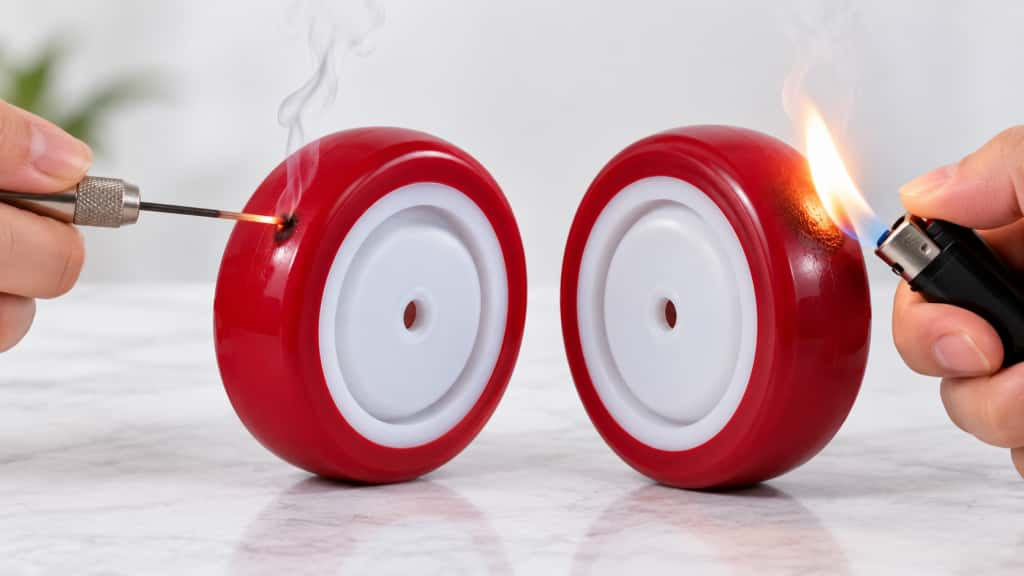
Why I am cautious with destructive checks
Some experienced factory people can identify materials by smell or burning behavior. I respect that practical experience. However, I also know that many purchasing and sales teams do not have safe testing conditions. Burning plastic materials can produce irritating or harmful fumes6, and a wrong test can damage a sample that should be kept for reference.
So I use a clear rule:
If a method creates smoke, odor, melting, or residue, I treat it as a controlled sample check, not a casual desk test.
What these checks may reveal
A controlled hot-needle or small shaving heat test may show how the material reacts to heat. In practical terms, people often observe:
- Whether the material softens quickly
- Whether the surface chars
- Whether it gives a sharp or irritating smell
- Whether smoke appears
- Whether residue becomes sticky, hard, or brittle
However, these reactions can vary because industrial wheel compounds are not always pure textbook materials. Additives, fillers, plasticizers, pigments, and processing methods can affect the result.
Safety-first guidance
If a team decides to use destructive checks, I suggest basic precautions:
-
Use only a small cut piece or shaving
Never damage the approved sample unless you have another reference sample. -
Work in a ventilated area
Smoke and fumes should never be inhaled directly. -
Keep flame away from cartons and packaging
Warehouses often contain flammable materials. -
Wear basic protection
Gloves and eye protection reduce unnecessary risk. -
Document the process
Photos, videos, and notes help future comparison. -
Do not rely on smell alone
Smell is subjective and can vary between people.
Practical risk table
| Method | Useful for | Main risk | Recommended use |
|---|---|---|---|
| Smell at room temperature | Quick impression | Subjective and unreliable | Very limited value |
| Hot needle | Small surface reaction | Fumes, sample damage | Controlled sample check |
| Burning small shaving | Material behavior clue | Smoke, odor, fire risk | Only with safety control |
| Lab material test | Stronger verification | Cost and time | Best for important orders |
When professional testing makes sense
Professional material testing may be worthwhile when the order value is high, the application is safety-sensitive, or the end user has strict performance requirements. For example, a medical equipment manufacturer, automated logistics system integrator, or precision manufacturing plant may need more than a hand check.
In those cases, I would not rely on smell or burning. I would ask for:
- Supplier material declaration
- Material data sheet if available
- Hardness report
- Load test information
- Wear or abrasion test references
- Third-party testing when justified
- Retained approved samples for comparison
The goal is not to make purchasing complicated. The goal is to match the verification level with the risk level. A low-cost DIY caster may not need the same review process as a wheel used under expensive industrial equipment. But if the quotation says PU and the application depends on PU-like performance, stronger confirmation is reasonable.
Why does distinguishing PU and PVC wheels matter for procurement?
Distinguishing PU and PVC wheels matters because wrong material expectations can affect wear life, load behavior, floor protection, noise, and total cost7. A sample may look acceptable at first, but the wrong tread material can create complaints after the wheels are already installed.
The real reason to identify the material is not curiosity. It is risk control. PU and PVC wheels can serve different use cases, budgets, and performance targets, so purchasers should connect material confirmation with actual operating conditions before approving bulk orders.
Performance expectations are different
In many industrial caster projects, PU wheels are chosen because they often offer a good balance of wear resistance, load capacity, floor protection, and rolling comfort. PVC wheels may be attractive for cost-sensitive applications, lighter-duty carts, retail channels, or certain general-purpose products.
But no material is automatically correct. I always ask about the working environment before recommending a wheel:
- What is the load per wheel?
- Is the floor epoxy, concrete, tile, or steel plate?
- Will the caster roll continuously or only occasionally?
- Is noise important?
- Is chemical exposure possible?
- Will the wheel be used indoors or outdoors?
- Is the project cost-driven or performance-driven?
These questions matter because the same wheel can perform well in one setting and fail early in another.
Where misunderstanding causes problems
Material confusion can create several commercial and technical issues:
-
Wear resistance complaints
If the customer expects PU-level wear performance but receives another material, service life may be shorter than expected. -
Floor protection concerns
A harder or less elastic tread may leave marks, increase vibration, or feel harsher on sensitive floors. -
Noise differences
The wheel may sound louder under load than the end user expected. -
Load behavior mismatch
The tread may deform, flatten, or roll differently under real working conditions. -
Total cost increase
A cheaper wheel can become expensive if replacement, complaints, or downtime increase.
Material choice should match the use case
| Application scenario | Common priority | Material discussion point |
|---|---|---|
| Industrial carts | Load and wear resistance | Confirm hardness, tread type, and load rating |
| Logistics trolleys | Rolling comfort and durability | Compare floor type and usage frequency |
| Food manufacturing | Cleanability and environment | Check chemical, moisture, and hygiene requirements |
| Medical equipment | Noise and floor protection | Confirm smooth rolling and documentation |
| DIY retail channel | Price and appearance | Make specifications clear to avoid returns |
| Precision manufacturing | Vibration control | Review wheel structure and tread performance |
Supplier evaluation should include material control
When I evaluate a caster supplier for a project, I do not only ask for price. I look for whether the factory can keep specifications stable across batches. For PU and PVC wheels, I like to confirm:
- Material name and grade description
- Tread hardness, such as Shore A value
- Wheel diameter and tread width
- Core material
- Bearing type
- Load rating and test method
- Sample approval process
- Packaging and labeling
- Batch consistency controls
- Whether certificates or reports are available for review
Any certification or test document should be treated as something to verify, not something to accept blindly. A professional supplier should be willing to explain what the document covers, whether it applies to the exact product, and whether it is still valid.
A practical procurement process I prefer
For bulk caster orders, I suggest a simple but disciplined workflow:
-
Define the application
Confirm load, floor, speed, environment, and expected service life. -
Request clear material specification
Ask whether the wheel is PU, PVC, rubber, TPR, nylon, PP, or another compound. -
Check physical samples
Use appearance, touch, rebound, and controlled checks if appropriate. -
Compare with known references
A known PU sample and known PVC sample can reduce confusion. -
Confirm hardness
Shore A hardness helps explain feel and performance. -
Approve a golden sample
Keep one sample for future incoming comparison. -
Confirm before shipment
Use photos, videos, sample recheck, or inspection for important orders.
This process does not eliminate every risk. However, it prevents many misunderstandings before they become claims. In my experience, clear specification and sample control save more time than arguing after goods arrive.
How should you confirm PU and PVC wheels before bulk orders?
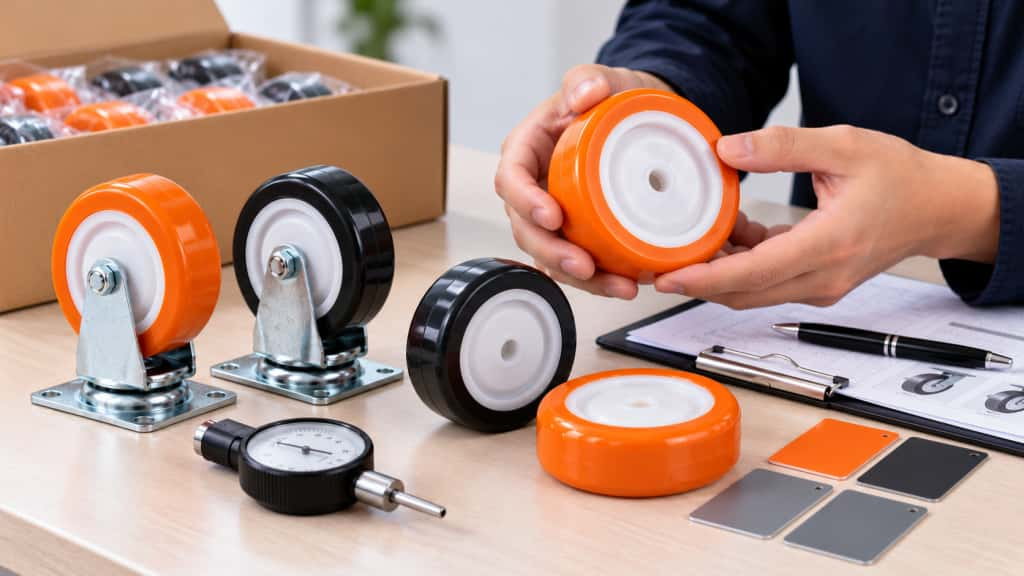
You should confirm PU and PVC wheels before bulk orders by combining practical sample checks with written specifications, supplier documentation, hardness confirmation, and approved reference samples. For high-risk applications, you should consider third-party or professional material testing.
The best approach is layered verification. Field checks help you form an early opinion, supplier documents clarify the claim, approved samples control expectations, and professional testing supports important decisions where material performance affects safety, cost, or customer satisfaction.
Why written confirmation matters
A physical sample is important, but a sample without written specifications can still create confusion. I have seen cases where two teams used different names for similar-looking wheels. One person called it PU because of appearance. Another called it PVC because of cost level. A third person only cared about color and size.
That is why I prefer written confirmation before bulk orders. It keeps everyone aligned.
A clear caster specification should include:
- Wheel material
- Tread hardness
- Wheel diameter
- Tread width
- Hub or core material
- Bearing type
- Bracket material and thickness
- Surface treatment
- Load rating
- Application notes
- Packaging requirements
Sample approval checklist
| Step | What to check | Why it matters |
|---|---|---|
| Quotation review | Material name and hardness | Prevents unclear comparison |
| Sample review | Appearance, touch, rebound | Screens obvious mismatch |
| Document review | Material declaration or data sheet | Supports supplier claim |
| Application review | Load, floor, environment | Confirms suitability |
| Golden sample | Retained approved sample | Controls future batch comparison |
| Pre-shipment check | Photos, video, inspection | Reduces bulk delivery risk |
Questions I ask suppliers
When I help a client evaluate caster wheels, I prefer direct and practical questions:
-
What is the exact tread material?
I avoid vague words like “plastic wheel” or “elastic wheel.” -
What is the Shore A hardness?
This is especially important for PU wheels because hardness can vary, such as 75°, 85°, 92°, or 95° Shore A. -
Is the sample made from the same material as bulk production?
A sample should represent the actual order. -
Can you keep the same formula and hardness across batches?
Consistency matters for distributors and OEM projects. -
Can you provide supporting documents?
Documents should match the exact wheel model when possible. -
Can we keep an approved sample for comparison?
This helps solve future disputes quickly.
When I recommend stronger verification
Not every order needs laboratory testing. However, I recommend a higher confirmation level when:
- The order quantity is large
- The customer has strict performance expectations
- The wheel will be used on expensive floors
- The caster supports costly equipment
- The application involves medical, food, precision, or automated systems
- A previous claim or complaint has occurred
- The price difference seems unusually large
In these cases, professional evaluation can be a good investment. It may include hardness testing, abrasion testing, load testing, or material identification by a qualified lab. I do not present myself as a chemical testing authority. My role is to help purchasers ask better questions, compare samples, and choose suitable caster supply options.
Keep the decision commercial and technical
A good caster decision balances performance, cost, and risk. PU may be the better option for one project. PVC may be suitable for another. The key is that the final product should match the specification, the quotation, and the real working environment.
For channel distributors, this matters because product returns damage margin. For equipment manufacturers, it matters because wheel failure can affect the entire machine experience. For hardware and building material wholesalers, it matters because sales teams need clear product positioning.
In short, material confirmation protects both sides of the transaction. It helps the supplier avoid unclear expectations, and it helps the purchaser avoid recommending the wrong caster for the job.
Frequently Asked Questions
Can I identify PU and PVC wheels by color?
No. Color cannot definitively identify PU and PVC wheels. PU can be red, gray, blue, black, or transparent, and PVC can also be made in similar colors or finishes. Color is only a first visual clue. You should confirm material through sample checks and supplier documentation.
Does a fingernail press test prove a wheel is PU?
No. A fingernail press test does not prove the wheel is PU. PU tread hardness can reach 75°, 85°, 92°, or 95° Shore A. At higher hardness levels, a fingernail may leave no visible mark. Use the test only as an initial field check.
Is PU always better than PVC for caster wheels?
No. PU is not always better than PVC. PU often performs well in wear resistance, floor protection, and load behavior, but PVC may be suitable for cost-sensitive, lighter-duty, or retail channel applications. The correct choice depends on load, floor type, usage frequency, budget, and expected service life.
Should I burn a wheel sample to check the material?
You should not casually burn a wheel sample in a warehouse or office. Burning or hot-needle checks can create fumes, odor, and safety risks. If destructive checking is needed, use a small controlled sample with proper ventilation and safety measures, or choose professional testing.
What should I ask a supplier before ordering PU wheels?
You should ask for the exact material, Shore A hardness, load rating, wheel size, core material, bearing type, and whether the bulk order will match the approved sample. For important projects, request supporting documents and keep a golden sample for future comparison.
Conclusion
PU and PVC wheels should not be judged by appearance alone. Color, gloss, and transparency can mislead even experienced sourcing teams. I recommend using appearance as a first filter, touch and rebound as practical field checks, and destructive heat-related methods only under controlled conditions. Before bulk orders, confirm the material claim with specifications, samples, and documents. If you need help selecting or verifying caster wheels for your market or equipment project, contact me for a practical sourcing review.
"Texturing Technologies for Plastics Injection Molding: A Review", https://pmc.ncbi.nlm.nih.gov/articles/PMC9416373/. Plastics engineering sources explain that colorants, additives, mold surface texture, and processing parameters can substantially influence the visible appearance of a plastic part, so appearance is a controllable production outcome rather than a definitive material test. Evidence role: mechanism; source type: education. Supports: Plastic appearance can be adjusted through additives, pigments, molds, surface texture, and processing conditions.. Scope note: The source would explain the mechanism generally and may not discuss caster wheels specifically. ↩
"Clear Castable Polyurethane Elastomer for Fabrication of ...", https://pmc.ncbi.nlm.nih.gov/articles/PMC3877836/. General polymer references indicate that PVC and polyurethane products can vary in transparency and opacity depending on formulation, additives, and pigments, supporting the caution that translucency alone does not identify the wheel material. Evidence role: general_support; source type: encyclopedia. Supports: PVC and polyurethane can be produced in forms with different optical properties, including transparent/translucent and opaque appearances.. Scope note: The evidence would be material-level support and not a direct survey of commercial caster-wheel appearances. ↩
"Mechanical properties evaluation of PVC/plasticizers and ...", https://www.academia.edu/52778696/Mechanical_properties_evaluation_of_PVC_plasticizers_and_PVC_thermoplastic_polyurethane_blends_from_extrusion_processing. Comparative polymer-mechanics literature describes polyurethane elastomers as materials with significant elastic recovery and resilience, while PVC properties vary strongly with plasticizer content and may behave more plastically in many formulations. Evidence role: mechanism; source type: paper. Supports: Polyurethane elastomers generally exhibit elastomeric recovery and resilience characteristics that differ from more rigid or plasticized PVC compounds.. Scope note: Because both PU and PVC properties depend on formulation and hardness, the source would support a typical tendency rather than a universal field-test rule. ↩
"Design and Performance of Polyurethane Elastomers ... - PMC", https://pmc.ncbi.nlm.nih.gov/articles/PMC7664240/. Polyurethane elastomer references report that PU elastomers are commonly specified by Shore hardness and can be formulated over a broad Shore A range, including grades in the approximate 75A to 95A region. Evidence role: definition; source type: research. Supports: Polyurethane elastomers are commonly specified by Shore A hardness and can be formulated across hardness levels that include the cited approximate range.. Scope note: The source may substantiate polyurethane elastomer hardness ranges generally rather than confirming the exact hardness specification of any individual wheel. ↩
"A viscoelasticity model for polymers: Time, temperature ...", https://www.sciencedirect.com/science/article/abs/pii/S0167663621000922. Polymer science references explain that temperature affects viscoelastic behavior, stiffness, and flexibility in polymeric materials, which supports the caution that touch-based material checks can change under hot or cold conditions. Evidence role: mechanism; source type: education. Supports: Polymer hardness, stiffness, and flexibility can change with temperature because polymer chains respond differently above and below transition regions.. Scope note: The source would explain temperature-dependent polymer behavior broadly and may not quantify the effect for a specific caster-wheel compound. ↩
"Polyvinyl chloride toxicity in fires. Hydrogen ...", https://pubmed.ncbi.nlm.nih.gov/946083/. Occupational safety sources warn that heating or burning plastics can release irritating or hazardous decomposition products, including acid gases from PVC and toxic smoke constituents from polyurethane combustion. Evidence role: expert_consensus; source type: government. Supports: Combustion or heating of plastics can release hazardous gases, irritants, smoke, and decomposition products.. Scope note: The source would support the general safety risk of burning plastics, not identify the composition of any particular wheel sample. ↩
"Rolling resistance of casters increases significantly after two ...", https://pmc.ncbi.nlm.nih.gov/articles/PMC8365014/. Materials-handling and ergonomics guidance identifies wheel material, hardness, load, and floor condition as factors affecting rolling resistance, vibration, floor interaction, durability, and maintenance burden. Evidence role: general_support; source type: institution. Supports: Wheel material selection influences wear, rolling resistance, vibration, floor compatibility, load behavior, and operating cost in material-handling applications.. Scope note: Such guidance would support the procurement logic generally rather than quantify the cost impact for PU versus PVC wheels in every application. ↩