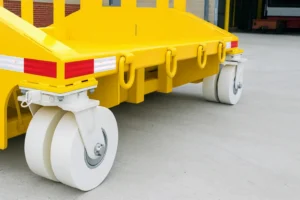
Moving heavy equipment is a huge pain. It can damage floors, or worse, cause injuries. Casters are the simple solution that makes moving heavy objects easy and safe.
A caster wheel1 is a complete assembly that includes a wheel and a mounting rig. This rig, or fork, attaches the wheel to an object. This allows the object to be moved easily. Many casters also swivel 360 degrees for better maneuverability.
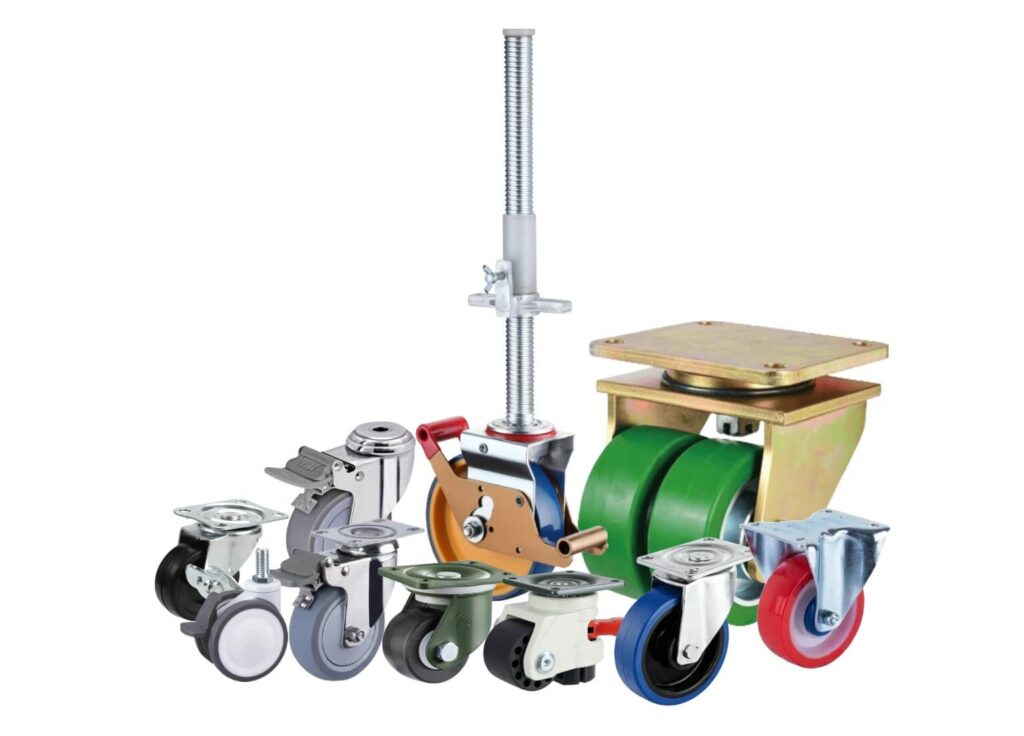
You might think a wheel is just a wheel. But in my 12 years in this business, I’ve learned the details make all the difference. The right caster can make a product great, while the wrong one can cause endless problems. Let’s dive into what makes a caster, and how you can choose the perfect one for your needs.
What is the difference between a castor wheel and a normal wheel?
You think a wheel is simple, but a basic wheel can’t steer. It just rolls forward and backward. A caster adds the ability to mount easily and turn in any direction.
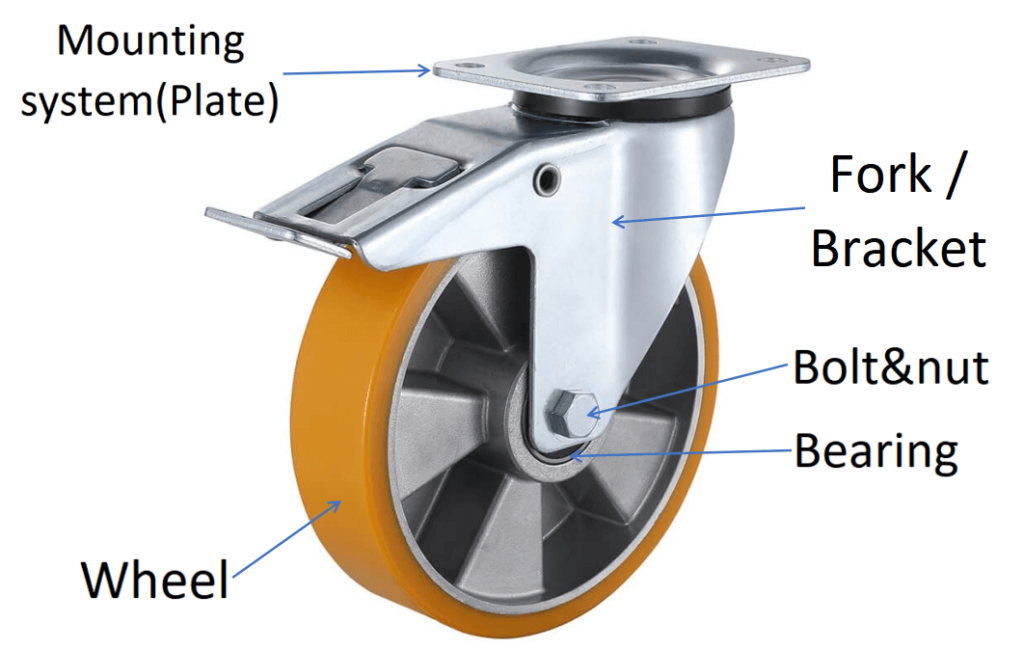
A normal wheel is just the circular part that rolls. A caster is the entire unit. It includes the wheel, the axle, and the bracket (fork) that attaches to your cart or equipment. The biggest difference is that a caster is a complete mobility system.
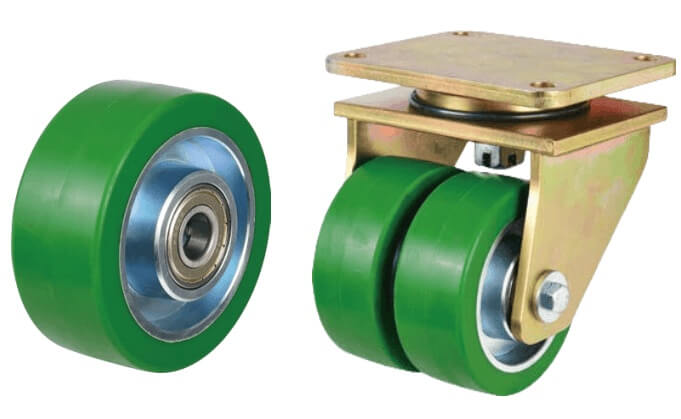
Let’s break this down further. A wheel is a component. A caster is a solution. When you buy a caster from us, you’re not just getting a wheel. You are getting an engineered assembly designed for a specific purpose. The assembly consists of a few key parts.
- The Wheel: This is the part that touches the ground. It can be made from many materials, like rubber, polyurethane (PU), or nylon.
- The bearing: Located inside the wheel, it enables smooth rotation and influences load capacity, rolling performance, and service life.
- The Axle(Bolt&nut): This is the pin that the wheel spins on.
- The Fork (or Rig): This is the metal bracket that holds the wheel and axle. It’s the main body of the caster.
- The Mount: This is the part of the fork that attaches to your equipment. It could be a flat plate with holes, a threaded stem, or another configuration.
Here is a simple table to show the difference:
| Feature | Simple Wheel | Caster Wheel Assembly |
|---|---|---|
| Components | Just the wheel | Wheel, bearing, axle, fork, mount |
| Function | Rolls in a straight line | Rolls, swivels 360°, mounts securely |
| Flexibility | Low | High |
So, the key difference is the integrated mounting and swiveling system. It turns a simple wheel into a powerful tool for movement.
What are the two main types of casters?
Choosing casters seems confusing. If you pick the wrong type, your cart will be hard to steer or won’t move straight. Knowing the two main types makes the choice simple.
The two main types of casters are swivel and rigid. Swivel casters can rotate 360 degrees, making it easy to turn and maneuver. Rigid casters, also called fixed casters, only move in a straight line, which provides stability and directional control.
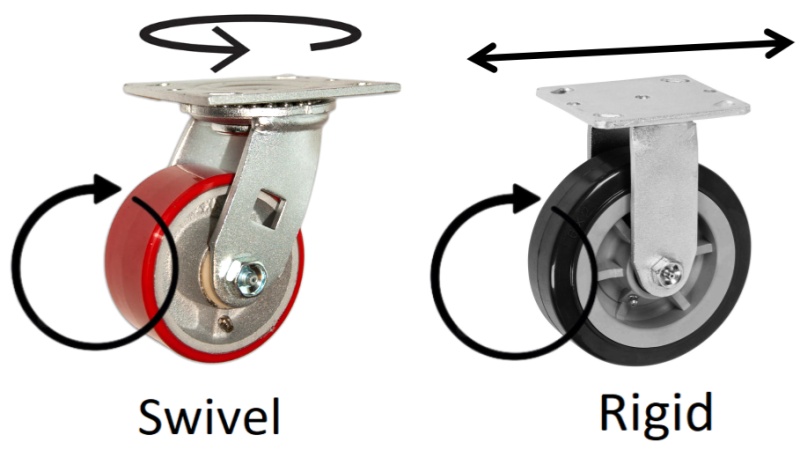
Understanding when to use each type is crucial. Most applications use a combination of both.
Swivel Casters
These are the workhorses of maneuverability. The fork can spin around a full 360 degrees. This is perfect for navigating tight corners and small spaces. You see them everywhere, from office chairs to store shopping carts. Their ability to change direction instantly is their biggest strength.
Rigid (Fixed) Casters
These casters are built for stability and straight-line tracking. The fork is fixed in place and does not turn. When you need to move a heavy load over a long distance, rigid casters ensure it doesn’t veer off course. A common setup is to put two [swivel casters](https://www.britannica.com/topic/wheelchair)[^4] on the front of a cart and two rigid casters on the back. This gives you both steering ability and control.
Beyond these two types, you also have different ways to mount them.
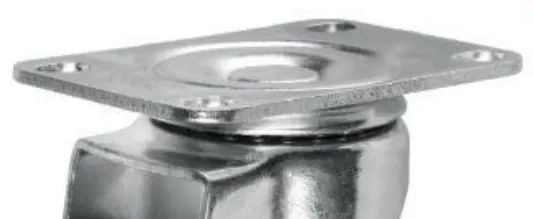
Top Plate: A flat metal plate with four bolt holes. This is very common for industrial carts.
Stem Mount: A single bolt or stem comes out of the top. This includes threaded stems, grip ring stems, solid stems, and hollow pipe stems.
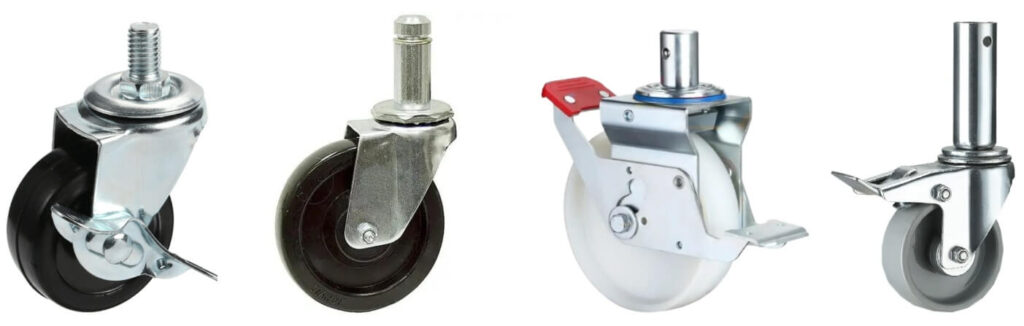
I’ve seen many unique mounting needs, like U-shaped, L-shaped, round-shpaed or special triangular plates. The mounting is just as important as whether it swivels or not.
Why are they called caster wheels?
The name “caster” can seem a little strange. You might wonder where it came from. The history of the name is actually quite interesting and has a couple of possible origins.
The name “caster” most likely comes from the word “cast,” which means to throw or direct something. A caster wheel “casts” the direction of the equipment it’s attached to. It allows you to direct its movement easily, unlike a fixed wheel.
The most accepted theory is that the name relates to the function. When you push a cart with swivel casters, you are casting its path. You direct it where you want it to go. This makes perfect sense.

There is another, less common theory that links the name to the Latin word “castor,” which means beaver. Some early furniture designs might have used materials or had a shape that reminded people of beavers, but this is less likely.
In our industry, the term is very specific. We say “caster” to mean the whole assembly. We say “wheel” to mean only the wheel part. This distinction is very important. It avoids confusion when a customer places an order. I’ve also noticed regional differences. In the U.S., it’s “caster.” In the U.K. and Europe, it’s often spelled “castor.”
The term also helps differentiate styles. We often talk about American, European, and Japanese style casters. They all have different design features. I once helped a client in Europe who needed American-style casters. Their new machine was from the U.S., and only the American mounting plate would fit. This shows how important precise language is in a global business.
What is the lifespan of a caster wheel?
You need casters that are reliable. A broken caster can bring your whole operation to a stop. Understanding what affects a caster’s lifespan helps you choose the right one from the start.
There is no fixed lifespan for a caster wheel. It depends heavily on the load it carries, how often it’s used, the environment, and the wheel material. A high-quality caster used correctly can last for many years, sometimes more than a decade.
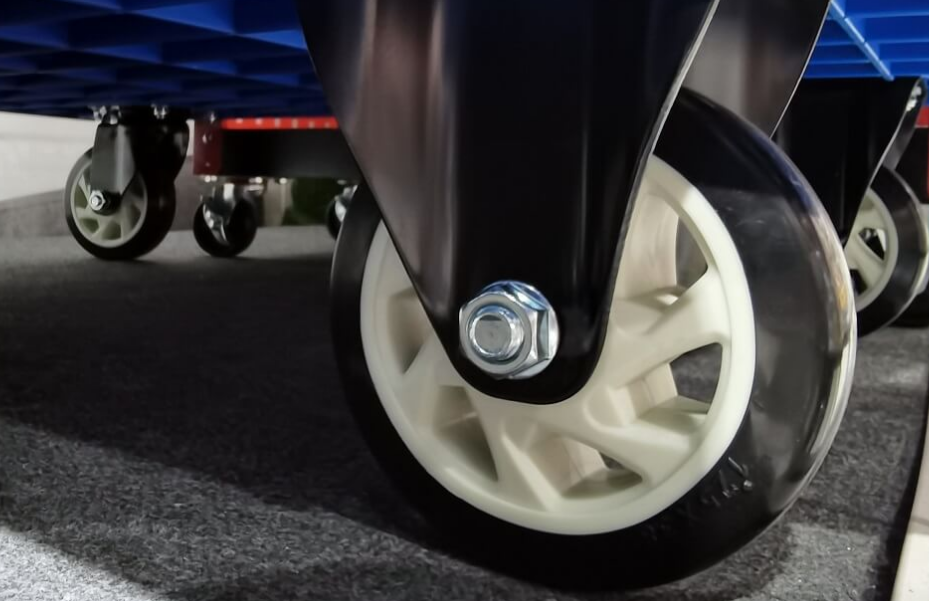
Several key factors determine how long a caster will last. You must consider all of them.
Load: Always stay below the maximum load capacity. Overloading is the fastest way to destroy a caster.
Environment: Is the floor smooth or rough? Are there chemicals, water, or extreme temperatures? Each of these factors can degrade the wheel material or the metal fork.
Usage: High speeds, long distances, and impacts from dropping or hitting obstacles all reduce lifespan.
Material: This is the most important factor you can control. Standard wheels are made of PU2, TPR3, or synthetic rubber4. But for special environments, you need special materials. We offer high-temp glass fiber wheels for food processing and cold-resistant nylon for freezers.
I remember a client who manufactured flight cases. They used standard elastic rubber wheels, which was the industry norm. I suggested they try TPE (thermoplastic elastomer) wheels instead. They provided the same shock absorption but were almost 15% cheaper. The client was thrilled, and the casters performed perfectly for their needs, extending the value of their product. Choosing the right material is everything.
Conclusion
A caster is an engineered system, not just a wheel. Choosing between swivel and rigid types and picking the right material for your environment is key to getting a long-lasting, reliable product.
- Understanding caster wheel definition, classification, and key specs is the foundation for selecting the right caster. ↩︎
- Understanding the characteristic of PU(polyurethane) can help you to make the right choice when selecting casters for your equipment. ↩︎
- Understanding the characteristic of TPR(thermoplastic rubber) can help you to make the right choice when selecting casters for your equipment. ↩︎
- In caster wheel industry, rubber casters are made of synthetic rubber, or a combination of specific materials and natural rubber. Understanding the characteristic of synthetic rubber can help you to make the right choice when selecting casters for your equipment. ↩︎