Are you sure all castor wheels are made the same? Many factories take shortcuts in manufacturing. This can cause big problems and hidden costs for you later on.
A quality castor wheel is made through a multi-stage process. It begins with shaping the metal housing via blanking and stamping1. Then, the parts receive a protective surface treatment. The wheel is created through injection molding2. Finally, all components are assembled, rigorously tested, and packed for delivery.**
The entire process is a chain where every single link is important. A failure in one step can weaken the final product, leading to poor performance and early failure. This journey from raw material to finished castor has many hidden details that determine quality. Let's look at each step, starting from the very beginning of the production line.
How are the metal parts of a castor shaped?
A castor's metal housing looks quite simple. But if it's not shaped with precision, it can lead to wobbly, unreliable castors that can't carry their load properly.
The metal housing starts as a steel coil. Machines then perform blanking to cut the basic shape, punching to create holes, and forming to bend it into the final bracket. For heavy-duty castors, welding is also used. The quality of the production molds is critical for this stage.
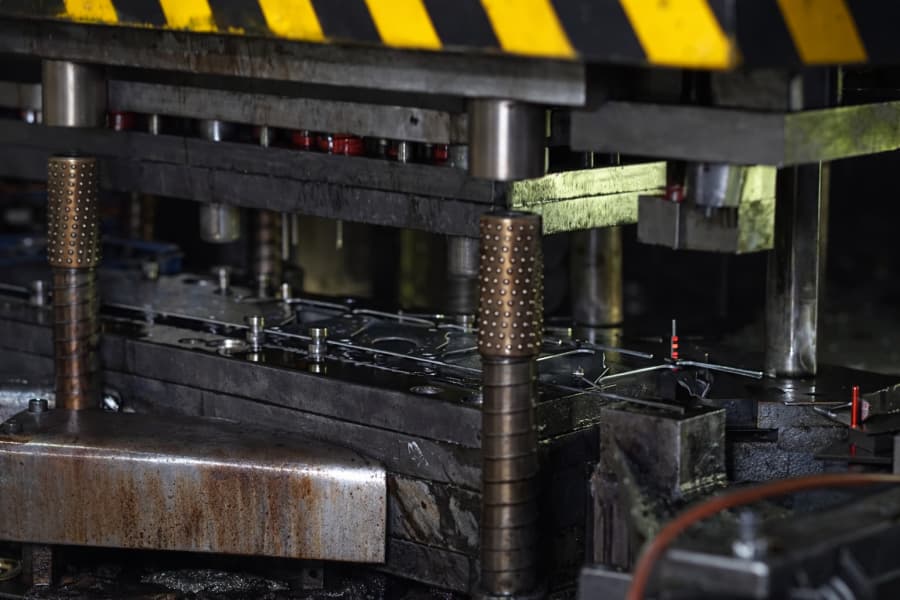
The first steps of making the metal fork, or housing, are blanking, punching, and forming. This is where the foundation of the castor's strength is built. However, the quality can vary a lot between factories. The difference often comes down to the tools and the process.
The Critical Role of Molds
The molds used for stamping are very important. A well-designed mold made from high-quality steel produces clean, precise parts. I've seen parts made with poor molds. They have rough, sharp burrs and ugly wrinkles in the metal. These parts don't just look bad; their dimensions are also off, which causes problems during assembly and use.
A Hidden Quality Step
Here’s a secret not many people know: some factories skip a step called "straightening" to save money. After a part like the top plate is stamped, it should be pressed a second time in a straightening mold. This makes the plate perfectly flat. A flat top plate ensures the castor swivels smoothly. Without this step, the castor can feel stiff or uneven when it turns. We never skip this step because smooth movement is a basic requirement for a good castor.
| Feature | High-Quality Process | Low-Quality Process (Cost-Cutting) |
|---|---|---|
| Mold Quality | High-grade steel, precise design | Cheaper steel, poor design |
| Part Finish | Smooth, clean, no burrs or wrinkles | Rough edges, burrs, surface wrinkles |
| Straightening | Performed for flatness and smoothness | Skipped to reduce cost |
| Result | Smooth rotation, accurate dimensions | Wobbly movement, poor fit, unreliable |
Why is surface treatment so important for castors?
Your new castor looks shiny and clean. But will it start rusting in a few months? The wrong surface treatment means it probably will, costing you more money over time.
Surface treatment, most commonly zinc plating3, is a protective layer. It shields the steel housing from rust and corrosion. The thickness of this plating is critical. It must meet standards to ensure durability and a long service life, preventing premature failure and replacement costs.
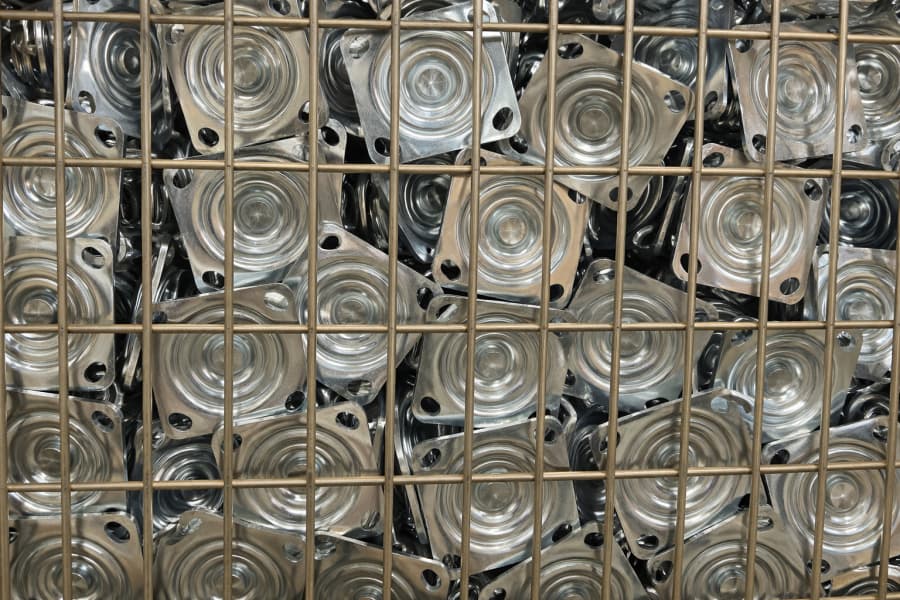
After the metal housing is formed, it needs protection. Raw steel rusts quickly, especially in damp environments. The most common way to protect it is with zinc plating, which gives it that familiar shiny finish. But not all zinc plating is the same. The thickness of the coating makes all the difference between a castor that lasts for years and one that rusts in months.
A Real-World Lesson in Quality
I remember a potential customer came to me with a sample from another supplier. He told me their price was lower than ours. I took a close look at his sample. The castor looked okay at first glance, but I suspected the low price came from a compromise in quality. We tested the zinc plating thickness in our lab. The European standard requires a thickness of 8-12 microns. His sample was less than 8 microns thick. I explained to him that while his initial purchase price was lower, the castor would rust much faster. This would force him to replace the castors more often, making his total cost much higher in the long run. He saw the logic, chose our product, and has been a satisfied customer ever since.
The Balancing Act of Plating
The 8-12 micron(1 micrometer=0.001 millimeter) range isn't arbitrary. It's a balance.
- Too Thin (<8 microns): The protective layer is weak. Scratches and exposure to moisture will quickly lead to rust.
- Too Thick (>12 microns): The plating can become brittle. I've seen cases where a very thick coating starts to flake or peel off, especially if the part is bent or impacted. This also exposes the steel underneath.
This is why we control our plating process so carefully. It ensures every castor we ship has a durable, effective, and long-lasting protective coat.
What makes a good castor wheel?
The wheel itself seems like a simple part. But a poorly made wheel can wobble, crack, or even leave marks on your floors. The secret to a good wheel is in the injection process.
A good wheel is created using precision injection molding. The right choice of material, a well-designed mold, and a properly calibrated injection machine are all essential. This combination ensures the wheel is perfectly formed, has a uniform tread, and can handle its specified load capacity.
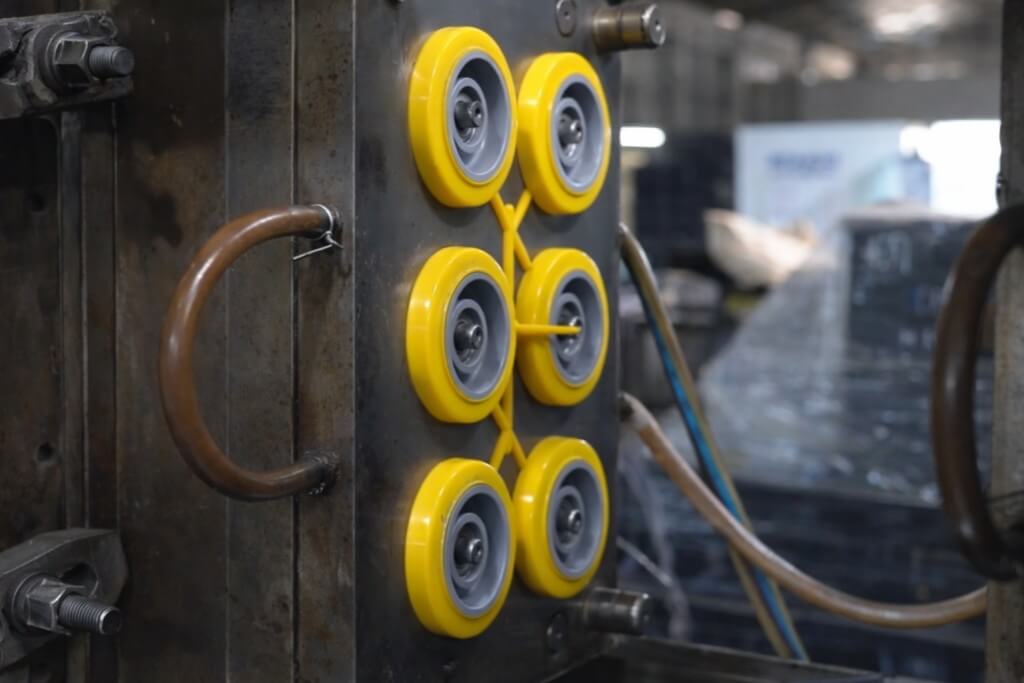
The wheel is the part of the castor that makes direct contact with the ground. Its quality affects everything from the smoothness of the ride to the safety of the load. The process of making the wheel, usually through plastic injection molding, is filled with details that matter.
How Mold Design Affects Performance
I once had to inspect a batch of wheels where the customer complained about a "bumpy ride." When I looked at the wheels, I found a small but noticeable bump on the surface of the tread. After investigating, we traced the problem back to the injection mold. The mold designer had placed the material "gate" —the entry point for the molten plastic—directly on the tread. This left a small, raised point on every wheel. A better design is to place the gate on the side of the wheel hub, where it doesn't affect the rolling surface. This experience taught me how a small design choice can have a big impact on the user's experience.
Choosing the Right Material
The material of the wheel is also critical. Different materials are suited for different jobs.
- Polyurethane (PU): A great all-around material. It's quiet, non-marking on floors, and resistant to oils and chemicals.
- Rubber: Offers the best shock absorption, making it ideal for rough surfaces.
- Nylon (PA): Very hard and has a high load capacity. It rolls easily but can be noisy and may damage delicate floors.
- Polypropylene (PP): A lower-cost option that is lightweight and resistant to water and chemicals.
We help our customers choose the best material based on their specific application, load, and floor conditions.
How are all the castor parts put together?
You have all the right parts ready to go. But if they are not assembled correctly, the castor can feel loose or even fall apart. Proper assembly is the crucial final step.
Assembly is the stage where the wheel, axle, and bearings are fitted into the metal housing. For swivel castors, ball bearings4 are added to the swivel head. The components are then securely fastened, often by riveting the kingpin to lock everything together.
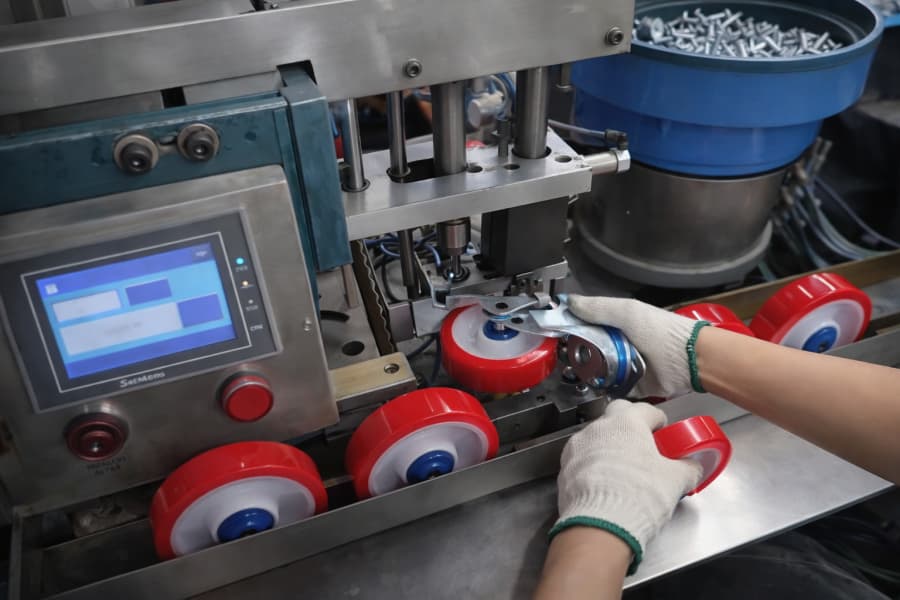
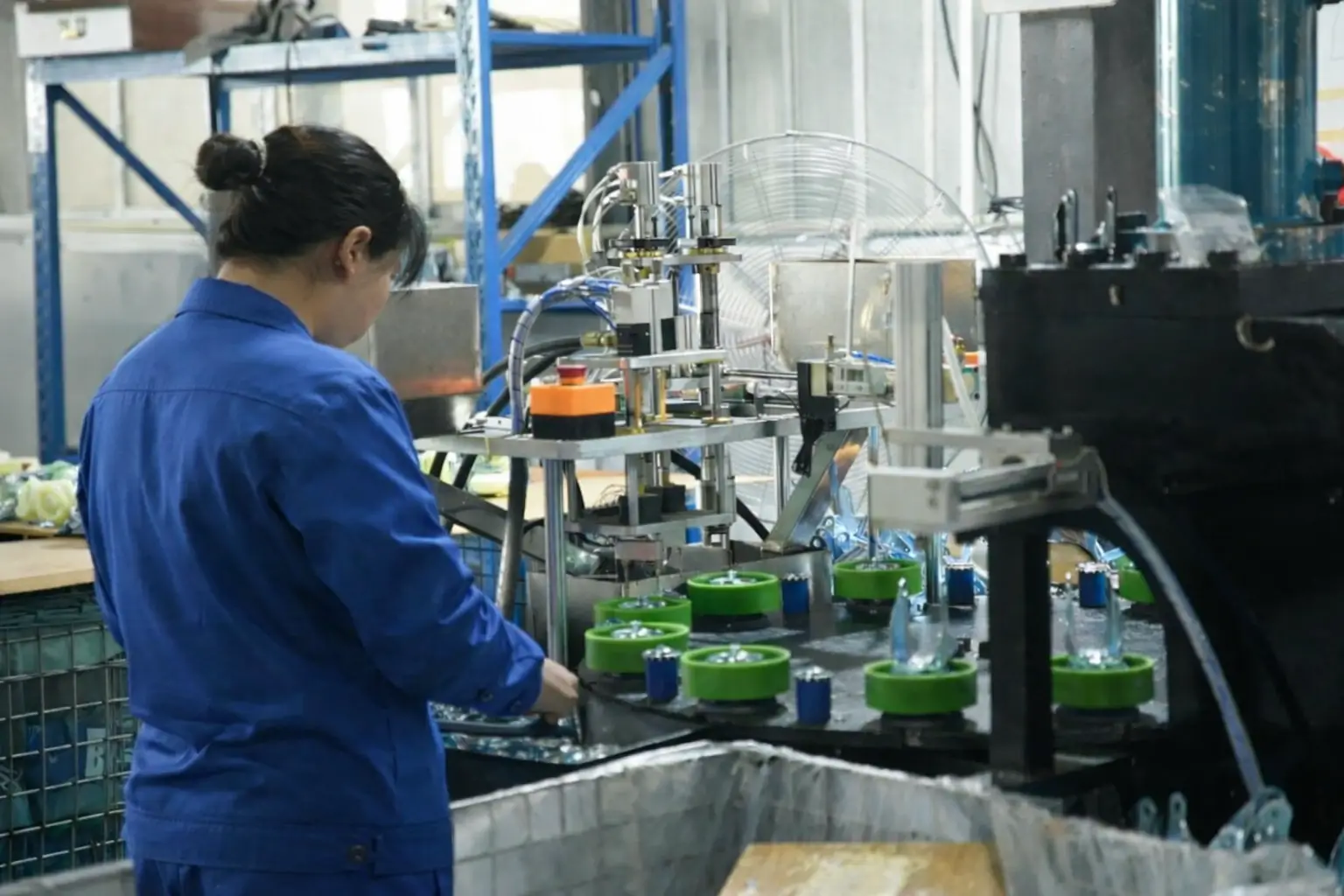
This is where all the carefully made components come together to form a functional castor. This process can be done manually, but for consistency and efficiency, we use semi-automated assembly lines. Every action must be precise to ensure the final product is both safe and reliable.
The Anatomy of a Swivel Castor
Let's break down what goes into a typical swivel castor during assembly:
- Fork/Housing: The stamped and plated metal bracket.
- Top Plate: The part that mounts to the equipment.
- Swivel Raceway: The track where the ball bearings sit, allowing the castor to turn. This is often filled with grease for smooth, long-lasting rotation.
- Ball Bearings: Small steel balls that reduce friction in the swivel head.
- Kingpin: The central pin that holds the fork and top plate together. It is permanently riveted during assembly.
- Wheel: The injection-molded wheel made of PU, Nylon, or another material.
- Wheel Bearing: Placed in the center of the wheel to allow it to spin freely on the axle. This can be a simple plain bore, a roller bearing, or a precision ball bearing.
- Axle & Nut: The bolt and nut that hold the wheel inside the fork.
Why a Secure Fit is Everything
The two most critical fastening actions are riveting the kingpin and tightening the axle. A poorly riveted kingpin will result in a wobbly swivel head that feels loose and can fail under a heavy load. An axle that is not tightened correctly can cause the wheel to wobble or even fall off. We use machines that apply a specific, measured force to ensure every rivet and axle is perfectly secured. This attention to detail during assembly is what transforms good parts into a great castor.
How do you know if a castor is good quality?
The castor looks good, but will it actually work? Will it fail when you need it most? Without proper testing, you are just guessing. We believe in proving quality, not just talking about it.
Quality is confirmed through a series of demanding tests. These include load capacity tests, durability test5 on a rolling machine, and salt spray test6 for corrosion resistance. These tests simulate real-world use and prove that the castors meet tough international standards like EN12527-125337, ANSI-ICWM-20188, or JIS B 89239.
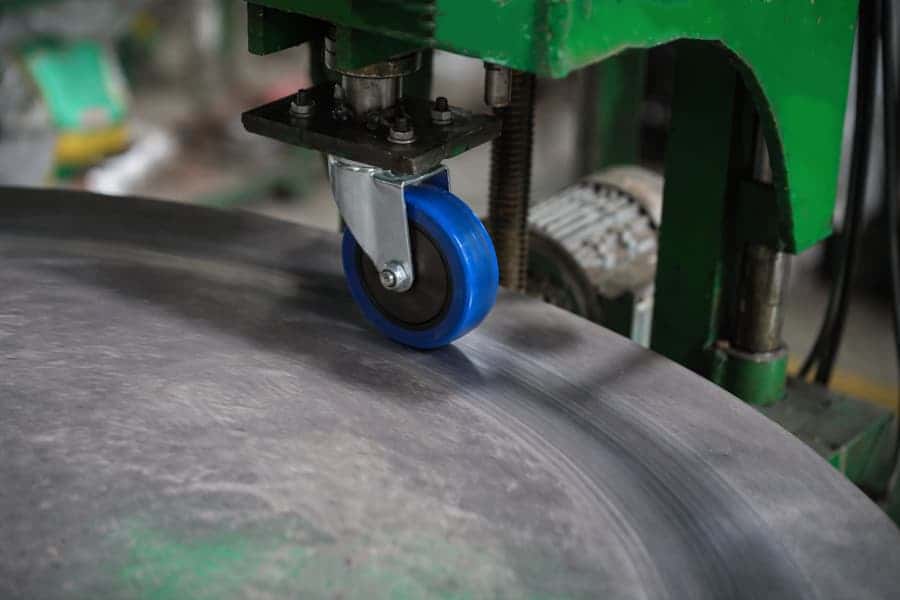
A claim of "high quality" is meaningless without proof. That's why testing is a non-negotiable part of our manufacturing process. We don't just test a few samples; we have a systematic quality control program that checks products at different stages. The final product tests are the most important, as they verify that the castor will perform as expected in the real world.
Simulating a Lifetime of Use
One of the most important tests is the durability test. We use a special machine that is like a treadmill for castors. The castor is mounted, a specific load is applied, and the machine makes it roll over a drum for a set distance, often many kilometers. To make it even tougher, the drum has obstacles welded onto it. The castor must roll over these obstacles thousands of times. This test simulates years of use on imperfect floors and proves the castor's structural integrity.
Verifying Strength and Durability
We perform several other key tests:
- Load Capacity Test: We apply force to the castor until it fails. This tells us its true static (standing still) and dynamic (moving) load capacities. We make sure it exceeds the rated capacity.
- Salt Spray Test: The castor is placed in a chamber filled with a salty mist for many hours. This is an accelerated corrosion test. It helps us verify that our zinc plating is thick enough to resist rust according to standards like EN84010.
- Brake Performance Test: For castors with brakes, we test the holding force of the brake on different surfaces to ensure it is effective and reliable.
These tests are how we guarantee that our castors meet the strict requirements of our customers and international standards like EN12532 for industrial castors or ANSI in the US.
Why does castor packaging matter?
It's just a box, right? That's a common mistake. Poor packaging can lead to damaged products, rust during transit, and major headaches for your warehouse team.
Packaging is the final, critical step to protect castors from damage and corrosion during shipping and storage. It also ensures efficient handling and inventory management. Good packing includes strong cartons, clear labeling with all necessary information, and protection from moisture.
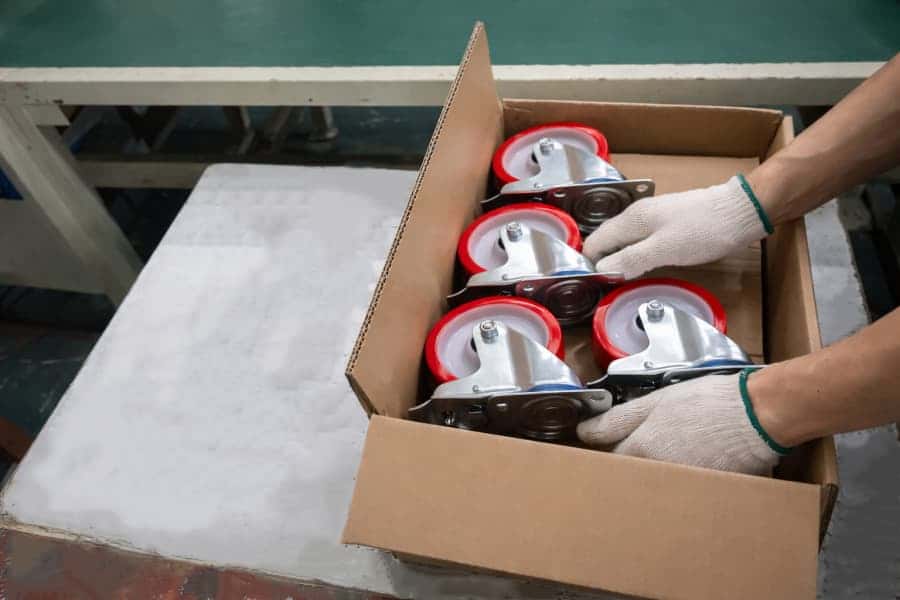
After all the hard work of manufacturing and testing, the final step is packing. This step is often overlooked, but it is essential for delivering the product to the customer in perfect condition. For our international customers, products spend weeks on a ship, so protecting them is a top priority.
More Than Just a Box
Effective packaging serves several functions.
- Protection: We use strong, multi-layered cardboard cartons. Inside, the castors are often placed in plastic bags to protect the finish and provide an extra barrier against moisture. For sea freight, we sometimes add desiccant packs inside the cartons to absorb any humidity.
- Efficiency: The way products are arranged in the box matters. We pack them to prevent movement and maximize the number of units per carton, which saves on shipping costs.
- Information: This is crucial for our customers, who range from large retailers to industrial distributors. Every carton is clearly labeled with the part number, quantity, dimensions, weight, and any customer-specific information like barcodes. This makes receiving and managing inventory simple and error-free.
Custom Packing for Different Needs
We understand that different customers have different needs. A large hardware chain like Home Depot might require retail-ready packaging, such as small branded boxes or blister packs that can be hung on a display. An industrial end-user, on the other hand, needs bulk packaging that is easy to open and dispose of on their production line. We are flexible and can provide customized packing solutions to match exactly what our customer requires. It's the final detail in a long process of delivering quality.
Conclusion
From shaping raw steel to packing the final box, every step in castor manufacturing matters. Quality is carefully built into the product, not just checked at the end.
Learn how blanking and stamping are crucial for precision in shaping metal parts, ensuring the reliability of the final product. ↩
Explore how injection molding ensures the perfect formation and durability of castor wheels, affecting their performance. ↩
Learn about the benefits of zinc plating in providing a protective layer that prevents rust and extends product life. ↩
Learn how ball bearings reduce friction and enhance the smooth movement of castor wheels. ↩
Explore how durability tests simulate real-world conditions to ensure castor wheels can withstand long-term use. ↩
Understand how salt spray tests verify the effectiveness of protective coatings against rust and corrosion. ↩
Discover the EN12527-12533 standards that ensure the quality and safety of industrial castors. ↩
Discover the ANSI-ICWM 2018 standard that ensure the quality and safety of industrial castors. ↩
Discover the JIS B 8923 standard that ensure the quality and safety of industrial castors. ↩
Discover the EN840 standard that ensure the quality and safety of trash container castors. ↩